 Maktab Quran
The direct answer: the best online Quran classes in the USA are live, teacher-led programs — not video courses or apps — with a structured curriculum, Tajweed-qualified teachers, genuine female-teacher availability, scheduling that fits US time zones, and a free trial you can use to verify all of it before paying. In 2026 that combination costs far less than most American families assume: from $12/month for a capped group batch to $60/month for daily 1-on-1 lessons at Maktab Quran, against a US market that ranges from $8–$15 per lesson for freelance tutors to $150+/month at premium academies. This guide compares every real option available to US families — including where we honestly stand among them — so you can choose well.
What does "best" actually mean for a Quran class?
Strip away the marketing and one thing separates programs that produce confident readers from programs that produce frustrated dropouts: how much individual recitation-with-correction each student gets per week. The Quran is learned by reciting to someone qualified who stops you at the exact mistake — that is how it has been transmitted for fourteen centuries, and no app or recorded course replicates it (here is exactly why self-study alone stalls). So when you compare "best of" options, the real question is never the brand name. It is: how many minutes per week will my child — or I — actually recite to a teacher who corrects us? Judge every option below, including ours, by that number.
What do online Quran classes cost in the USA in 2026?
Here is the honest market picture, based on advertised US pricing across the main categories:
| Option | Typical 2026 cost | What you get |
|---|---|---|
| Masjid weekend school | $20–$50/mo (often donation-based) | 1–2 group sessions a week, in person, community setting |
| Freelance tutor marketplaces | $8–$15 per half-hour | Pay-per-lesson; vetting and curriculum are your job |
| Established online academies | $30–$80/mo | Usually 2–3 classes/week, 1-on-1 or small group |
| Premium academies | $100–$150+/mo | Daily classes, senior teachers, formal programs |
| Maktab Quran — 1-on-1 | $60/mo | Five live 30-min private lessons/week (~$3 a lesson), synchronized Quran screen |
| Maktab Quran — group batch | $12/mo | Five live 30-min classes/week, capped at 10, every student recites every class |
What the named academies actually charge
Ranges are hard to act on, so here is the same comparison with the academies named and the figures read from their own public pricing pages. Every provider is shown at the same thing: twenty 30-minute one-to-one classes a month, which is ten teaching hours.
| Provider | Per month | Per teaching hour | What that buys |
|---|---|---|---|
| IQRA Network — Elite | $160 | $16.00 | Priced by service level, not lesson length: quarterly coaching sessions and reports, unlimited rescheduling, 10% family discount. |
| IQRA Network — Pro | $120 | $12.00 | Coaching twice yearly, up to 4 reschedules a month, 5% family discount. |
| Shaykhi Academy — Plan E | $94.99 | $9.50 | Stated hourly rate $9.50. Auto-renews monthly. “Family10” coupon gives 10% off. |
| IQRA Network — Simple | $90 | $9.00 | Entry tier. Same teacher and materials as the higher tiers; less coaching and reporting. |
| Mishkah Academy | $100 (listed at $85 discounted) | $8.50–10.00 | A “discounted” column sits permanently alongside the regular one. Publishes a 30-day money-back guarantee — the only academy in this comparison that does. |
| QuranHost | Not published | — | Prices are behind a form. Advertises monthly vs yearly billing with 10% off annually, a currency selector, and 10% off per additional sibling. |
| Hidayah Network | Not published | — | Prices are behind a form. States USD only, and no card details stored. |
| Maktab Quran — 1-on-1 | $60 | $6.00 | Five live 30-minute private lessons a week with a teacher you choose and keep. Synchronized Quran screen. Free trial, no card required. |
| Maktab Quran — group batch | $12 | $1.20 | Five live 30-minute classes a week, capped at ten students, every student recites in every class. No comparable product exists at the other academies listed. |
How we measured this. Each figure was taken from that academy's own public pricing page and normalised to twenty 30-minute one-to-one classes a month, so the comparison is like-for-like rather than headline against headline. Where an academy does not publish its prices we say so rather than guess. We re-check these figures before each update; they were last verified on 5 September 2026. If you spot a figure that has changed, tell us and we will correct it.
Where the others beat us. Mishkah publishes a 30-day money-back guarantee and we do not. IQRA includes lesson recordings on every tier and we do not record lessons at all. QuranHost and IQRA both offer sibling discounts; we currently offer none. If any of those matter more to you than price, they are real reasons to choose one of them over us.
The comparison that matters is cost per corrected lesson, not cost per month. A $90/month academy giving two classes a week is about $11 per lesson; a marketplace tutor at $12 per half-hour is $24+/week for daily contact. Five weekly lessons at $60/month works out to roughly $3 per lesson — full pricing detail, including what is deliberately not charged for, is on our pricing page, and the budget angle has its own guide: affordable online Quran classes.
The 7 markers that separate the best programs
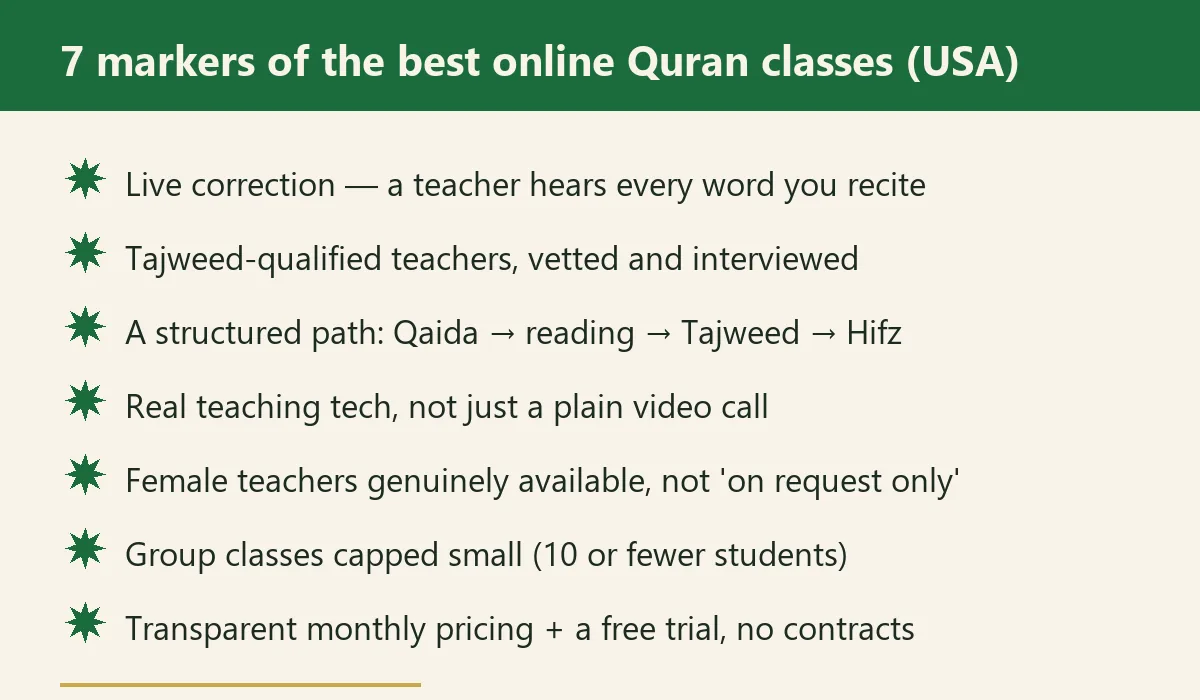
- A live correction loop. Every lesson, the student recites and a teacher corrects in real time. If the product is videos, an app, or a lecture the student watches, it fails the first test — here is what live actually looks like.
- Tajweed-qualified, vetted teachers. Ask where teachers trained and how they were tested. "Native Arabic speaker" alone is not a qualification; formal Tajweed training is.
- A structured path. The classical sequence — Noorani Qaida for letters, then fluent reading, then Tajweed refinement, then optional Hifz — with clear progression, not open-ended "conversation classes."
- Real teaching technology. A plain Zoom call means the teacher says "no, the third word" and the child hunts for it. A synchronized Quran screen highlights the exact word on the student's screen as the teacher marks it.
- Female teachers who actually teach. Many US families — women learning for themselves, parents of daughters — need this. "Available on request" often means one overbooked teacher; ask how many are on staff now.
- Capped group sizes. Group pricing is legitimate only when the batch is small enough that every student recites every class. At 20–30 students, a child can attend for months and recite for minutes — the arithmetic is in our 1-on-1 vs group comparison.
- Transparent pricing and a free trial. Monthly billing, no long contracts, and a trial lesson that lets you verify markers 1–6 before a dollar leaves your account.
Your real options in the USA, compared honestly
| Masjid weekend school | Marketplace tutor | Online academy | Maktab Quran | |
|---|---|---|---|---|
| Individual recitation time | A few minutes per session | Full lesson (if the tutor is good) | Varies — ask the batch size | Full 30 minutes (1-on-1) or every-class recitation (batch of ≤10) |
| Teacher vetting | By the masjid | Yours — reviews only | By the academy | Interviewed & Tajweed-tested; meet them |
| Scheduling | Fixed weekends | Negotiated per tutor | Fixed slots | Flexes to your family, all US time zones |
| Community & in-person contact | Excellent — its real strength | None | None | None — online only |
| Monthly cost (daily contact) | N/A (weekly only) | $160–$300 | $60–$150 | $60 (or $12 group) |
Two honest notes on that table. First: if you live near a masjid with a strong, small weekend program, take it seriously — community and in-person mentorship matter, and online classes complement rather than replace them (many of our families do both). Second: a genuinely excellent marketplace tutor can equal any academy — the catch is that finding, vetting and keeping one is unpaid project-management work that most parents underestimate; our guide to choosing an online Quran teacher lists the exact questions to ask whichever route you take.
Will classes fit your US time zone?
This is where many overseas-based academies quietly fail American families: their teachers' daytime is your midnight. Ask for the actual weekly slots in your zone before signing up. Maktab teachers cover Eastern, Central, Mountain and Pacific schedules — before-school mornings, after-school afternoons (3–6 pm local), evenings and weekends — and because scheduling is per-family rather than fixed-cohort, a Houston family's 5 pm CST and a New Jersey commuter's 6:30 am EST are both normal bookings, whether you are in Houston, Chicago, Dallas or a small town three hours from the nearest masjid — which is precisely the case where "Quran classes near me" is best answered online.
Female Quran teachers for women and girls
A large share of the "best online Quran classes USA" search is really a search for a qualified female teacher — women learning for themselves after years away, and parents of teenage daughters. Ask any shortlisted program two questions: how many female teachers are teaching this month, and can you have one for a trial lesson this week? At Maktab, female teachers run both private lessons and ladies' group batches, the platform is female-owned, and our classes for women page covers how sisters typically structure their learning.
For kids balancing American school schedules
The programs that work for US kids share a shape: short, frequent lessons (five 30-minute sessions beat one 2-hour Sunday marathon), timed after school so Quran practice becomes as routine as homework, with a teacher trained to keep a 7-year-old engaged through a screen. Our Quran for kids program is built exactly on that shape, and if you are wondering when to start, here is the honest answer on the best age to begin.
Where Maktab Quran honestly stands
You are reading this on our website, so here is the same honesty we demand of everyone else. Our weaknesses: we are a young platform (launched 2026), our teacher roster is smaller than academies that have operated for a decade, and we have no physical campus — if in-person community is your priority, a strong local masjid program beats us on that axis. Our strengths: every plan includes five live classes a week with individual recitation (the marker most programs fail); our synchronized Quran screen shows the student the exact word being corrected; female teachers genuinely teach; and pricing is $60/month 1-on-1 or $12/month in a batch capped at ten — a price set deliberately so cost never stops a family from learning. The full self-scored checklist — including the row where we score ourselves lowest — is in our global guide to the best online Quran classes.
How to test any program free before paying
Every claim above — ours included — is verifiable in one free trial lesson. In that half hour, check five things: (1) did the student recite for most of the lesson, or watch? (2) did the teacher catch and correct specific mistakes, kindly? (3) did the technology make the correction visible, or was it "no, the other word"? (4) was the slot offered actually sustainable in your time zone every week? (5) did your child want lesson two? A program that passes all five is the best online Quran class in the USA for your family — whoever runs it.
Quran classes in your city
Every lesson is online, so where you live changes the timing and nothing else — but the local picture is different in every city, and we have written it out for each one. Start with New York, Los Angeles, Chicago, Houston, Dallas, Washington DC, Detroit, Atlanta, Minneapolis or Seattle — or see the full list on our USA page.